
First Things First Book Summary: A Practical Guide for New Leaders

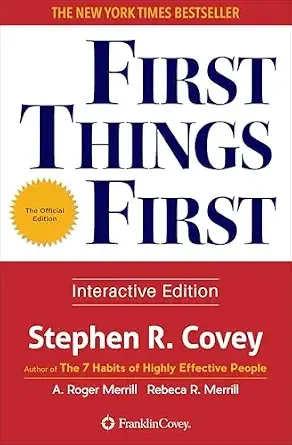
Explore our First Things First book summary for new leaders. Learn to set priorities, delegate effectively, and make time to support your team.
You started the day with good intentions.
You planned to prepare for a team conversation, clarify responsibilities on a project, and spend time helping an employee who needs support.
Then the messages arrived. Someone needed approval. A meeting ran long. A problem landed on your desk because you were the person who knew how to fix it.
By the end of the day, you had worked hard. The leadership work you intended to do was still waiting.
If that sounds familiar, First Things First offers a useful starting point for changing how you choose and protect your priorities.
Written by Stephen R. Covey, A. Roger Merrill, and Rebecca R. Merrill, the book explores how to align your personal and professional choices with what matters most. For new and emerging leaders, that raises an important question: Does the way you spend your time support the leader you want to become?
This article introduces several central ideas and shows how you can apply them when you are leading others, learning your role, and still carrying responsibilities of your own.
Buy "First Things First" on Amazon
First Things First: The Main Idea
First Things First encourages a principle-centered approach to managing your responsibilities. Your values, relationships, and meaningful goals should guide your choices.
That requires looking beyond the immediate satisfaction of completing tasks. You can finish a long list while leaving your most important commitments unattended.
For a new leader, the practical application is straightforward: make deliberate room for the work that helps your team succeed.
That might mean preparing someone to take ownership of a task, resolving unclear expectations, or addressing a concern before it damages a working relationship.
Those activities deserve a place in your week even when nobody is asking you to do them.
1. Choose Your Direction Before Filling Your Calendar
Covey’s distinction between the clock and the compass is especially relevant to leadership. The clock represents schedules and time commitments. The compass represents direction and priorities. FranklinCovey continues to use this distinction when teaching the habit of putting first things first.
A full calendar tells you where your time is going. It does not tell you whether your commitments deserve that time.
When you first become a leader, familiar work can feel especially rewarding. You know how to complete it. You can see the result. Helping someone else learn may feel slower and less certain.
Consider a newly promoted customer service supervisor who continues handling every difficult customer conversation personally.
The supervisor solves immediate problems, but employees have few opportunities to practice. The team keeps depending on the supervisor, whose workload keeps growing.
A useful leadership priority would be to prepare one employee to handle a specific type of complaint independently, with clear limits and support.
Apply it this week
Before reviewing your task list, answer:
- What result does my team most need this week?
- Who needs clarity, feedback, or support from me?
- What am I doing that someone else could learn to own?
Use your answers to choose where your leadership attention belongs.
2. Separate Urgency From Importance
The Time Matrix distinguishes activities by urgency and importance. FranklinCovey emphasizes protecting important work that does not yet carry immediate pressure, including preparation and prevention.
Here is how those categories might appear in a new manager’s week:
| Category | Leadership example | Practical response |
|---|---|---|
| Urgent and important | A serious customer issue or a deadline at risk | Address it, then examine what contributed to it |
| Important but not urgent | Coaching, onboarding, planning, and clarifying expectations | Reserve time and follow through |
| Urgent but not important | A routine request that does not need your involvement | Clarify ownership, redirect, or negotiate timing |
| Neither urgent nor important | Habitual checking and activity with little purpose | Reduce or remove it |
Classify the activity by its consequences. A message from an employee could be a routine question, a warning about a serious problem, or a request for help that only you can provide.
Apply it this week
Choose one recurring interruption and ask:
What could I clarify, teach, or improve so this becomes easier for the team to handle?
For example, repeated requests for approval may point to unclear decision authority. A short conversation about what an employee can decide independently may be more useful than answering the same question five more times.
You will still face genuine emergencies. The opportunity is to identify which repeated problems you can help prevent.
3. Give Leadership Work a Place in Your Week
Weekly planning creates room to act on your priorities before daily demands consume your attention. FranklinCovey’s planning guidance connects weekly and daily actions with meaningful goals, preparation, and prevention.
For a new leader, a useful weekly plan should account for both personal deliverables and responsibilities to the team.
“Support my employees” is a worthy intention. It becomes actionable when you decide what support is needed and when you will provide it.
For example:
| Responsibility | Specific commitment |
|---|---|
| Deliver results | Confirm the owner and next milestone for the team’s main project |
| Develop people | Help one employee prepare to lead a customer meeting |
| Build trust | Follow up on a concern raised during a one-on-one |
| Improve how work gets done | Clarify a handoff that repeatedly causes delays |
| Maintain personal capacity | Protect a commitment that supports your health or family |
Keep the plan realistic. Choose commitments you can carry through alongside existing deadlines and operating demands.
A conversation to have with your manager
If your individual workload leaves little room to lead, make the competing demands visible:
“This week I’m responsible for completing the report and preparing two employees to take over the new process. With the customer deadline, I expect a capacity conflict. Which outcome should take priority, and what can we adjust?”
Bring a recommendation when you can. Your manager may be able to change scope, timing, or ownership once the tradeoff is clear.
4. Help People Build the Ability to Solve Problems
For leaders who value service, being helpful can become a difficult habit to examine.
When someone struggles, you step in. When a deadline approaches, you take over. When a decision feels uncertain, you make it yourself.
Sometimes direct intervention is necessary. Repeated intervention also deserves examination.
Ask yourself:
Is my involvement helping this person become more capable?
Imagine an employee brings you a routine scheduling problem. You could rearrange the schedule yourself. You could also help them work through the decision:
“What options have you considered? Which one would you recommend? Let’s check it against our coverage requirements.”
If they lack the knowledge to answer, teach the missing skill. If they understand the task but lack authority, clarify what they can decide. If the risk is high, stay closely involved.
The amount of support should fit the employee’s readiness and the consequences of the decision.
Apply it this week
Choose one recurring responsibility you currently handle. Agree with an employee on:
- The result they will own.
- The standards and deadline.
- The decisions they can make.
- The situations that require your involvement.
- When you will check progress.
This takes preparation. It also gives the employee a fair opportunity to succeed without guessing what you expect.
5. Protect Important Commitments With Clear Conversations
Putting priorities into practice often requires discussing limits.
That can feel uncomfortable when you are new to leadership. You want to demonstrate commitment, earn trust, and be someone others can rely on.
Reliability includes being honest about what you can deliver.
When a new request arrives, clarify its importance, deadline, and effect on existing commitments.
When your manager adds work
“I can take this on. To meet Friday’s deadline, I would need to move the onboarding update to next week. Is that the right tradeoff?”
When a colleague asks you to take over
“I can help you think through the next step. Who owns the final decision, and what support do you need from me?”
When someone needs help during protected work time
“I’m preparing for the performance conversation at two. Is there a customer, safety, or deadline issue that needs attention now? If it can wait, let’s talk at three.”
These conversations help people understand your commitments and make better decisions with you. They also leave room for a genuinely urgent need.
Buy "First Things First" on Amazon
A 20-Minute Weekly Planning Exercise for New Leaders
The following exercise is a practical application of the ideas discussed above. It is designed for a manager who needs a simple way to turn priorities into action.
Minutes 1–5: Review what happened
Look at the previous week.
What moved forward? What kept returning to your desk? Which conversation or responsibility did you postpone?
Choose one pattern that deserves attention.
Minutes 6–10: Choose three outcomes
Identify three outcomes for the coming week:
- A result: What needs to be delivered?
- A people commitment: Who needs support, feedback, or development?
- A preventive action: What can you clarify or improve to reduce a recurring problem?
For example:
- Submit the project proposal by Thursday.
- Help Jordan prepare to run Monday’s team meeting.
- Agree on who approves routine customer credits.
Minutes 11–15: Reserve time
Put the necessary preparation, conversations, and follow-up on your calendar.
Leave room for the normal demands of your role. If the week is already full, identify the tradeoff before making another commitment.
Minutes 16–20: Communicate
Tell the relevant people what you have agreed to do.
Confirm ownership, deadlines, and any changes to existing plans. A priority becomes easier to act on when the people involved share the same expectations.
At the end of the week, review what happened and make the next plan more realistic.
Reflection Questions for New and Emerging Leaders
Use these questions for personal reflection, mentoring, or a leadership development discussion:
- What important leadership responsibility keeps getting postponed?
- Which recurring problem might improve with clearer expectations or better preparation?
- Where am I taking over work someone else could learn to own?
- Which commitment needs an honest conversation about time or capacity?
- What would my team notice if I followed through on one important priority this week?
Choose one question and act on your answer. A small commitment carried through can teach you more than a long list of intentions.
Frequently Asked Questions
What is the main lesson of First Things First for a new leader?
Use your values and important responsibilities to guide how you spend your time. A practical starting point is to reserve time for a specific team need, such as coaching an employee or clarifying expectations.
How can I apply these ideas when I have little control over my schedule?
Start with a commitment small enough to protect. Prepare one useful conversation, clarify one responsibility, or address one recurring source of confusion. Discuss larger workload conflicts with your manager using specific examples and proposed tradeoffs.
What if everything feels urgent?
Check the consequences and deadlines. Ask what must happen now, what can wait, who owns the decision, and what would be affected by a delay. When priorities conflict, seek agreement from the person responsible for deciding between them.
Your Next Step: Choose One Leadership Priority
Think of one action that would help someone on your team succeed.
It might be a conversation you have postponed, a responsibility you need to clarify, or an opportunity to help an employee take greater ownership.
Write it down. Decide when you will do it. Follow through.
Each time you make room for an important responsibility, you practice becoming a more dependable and purposeful leader.
Buy "First Things First" on Amazon
Want practical support as you grow into leadership? Subscribe to Leader’s Compass: Weekly Leadership Guide for tools, useful principles, and learning activities to help you build trust, communicate clearly, and lead your team with confidence.
Subscribe to my newsletter
Subscribe for tools, useful principles, and learning activities to help you build trust, communicate clearly, and lead your team with confidence.